The conversation may begin like an ordinary hello
It is easy to imagine that a scam will begin with an immediate demand for money. Some conversations instead start with a reaction to a post or a friendly greeting, continue naturally for several days, and introduce an investment only after trust has formed. A familiar photo or writing style does not make a request for money or personal information safe.
In May 2026, South Korea’s Financial Services Commission said criminal groups were moving beyond phone calls and texts toward social-media and messenger schemes, including investment chat-room fraud and romance scams. That statement is not an Instagram-only statistic, but it explains why a relationship that begins in a DM and later turns into an investment pitch deserves a separate check.
A profile photo and follower count cannot prove identity
Names, photos, and posts can be copied, and a real account can also be compromised. A large follower count or a long-looking post history does not prove that the person currently messaging you controls the account legitimately.
A verification badge can help identify an account associated with a real person or brand, but it does not certify that an investment promoted by that account is safe. The absence of a badge does not prove impersonation either. Compare two or three independent signals instead of relying on one symbol.
Verify the account outside the DM before sending money
Do not use the link supplied by the sender. Search for the person or company independently or type its official website address yourself. Follow the social link from that website, then compare the exact username with the account messaging you, including small spelling differences.
Instagram’s three-dot profile menu may include “About this account,” where you can see information such as when the account joined and how many times its username has changed. A recently created account, or one with repeated name changes, can be a reason to check further when it claims to be a long-established official account. This information cannot establish fraud by itself.
If the sender names a Korean financial firm or investment business, search for it separately through the Financial Supervisory Service’s FINE portal. A scammer can copy the name of a registered company, so also compare the official website and contact details. Readers elsewhere should use the equivalent register maintained by their local financial regulator.
It is reasonable to stop when these warning signs appear
The fear of missing a good opportunity can create the riskiest moment. Police guidance on illegal investment chat rooms describes overlapping pressure tactics: guaranteed principal or high returns, movement to an open chat, fabricated profit screens, and impersonation of celebrities or financial-company staff.
If even one of the following appears, do not rush to reply. Leave links and files unopened and show the conversation to someone you trust.
- The sender promises guaranteed principal, fixed returns, or recovery of a previous loss.
- They immediately move the conversation to Telegram, an open chat, or another outside messenger.
- They require registration on an unfamiliar investment app or website.
- They demand another tax, verification fee, or deposit before allowing a withdrawal.
- They request payment to a personal account or keep changing the destination account.
- They ask for an ID document, password, verification code, or screen sharing.
Save the account and conversation before you report it
Capture the profile URL and username, the full DM conversation, any outside chat-room address, the payment account, and every link. Blocking first can make those details harder to recover. The purpose of the screenshots is to explain the incident to the platform, a financial institution, or investigators—not to publish another person’s information.
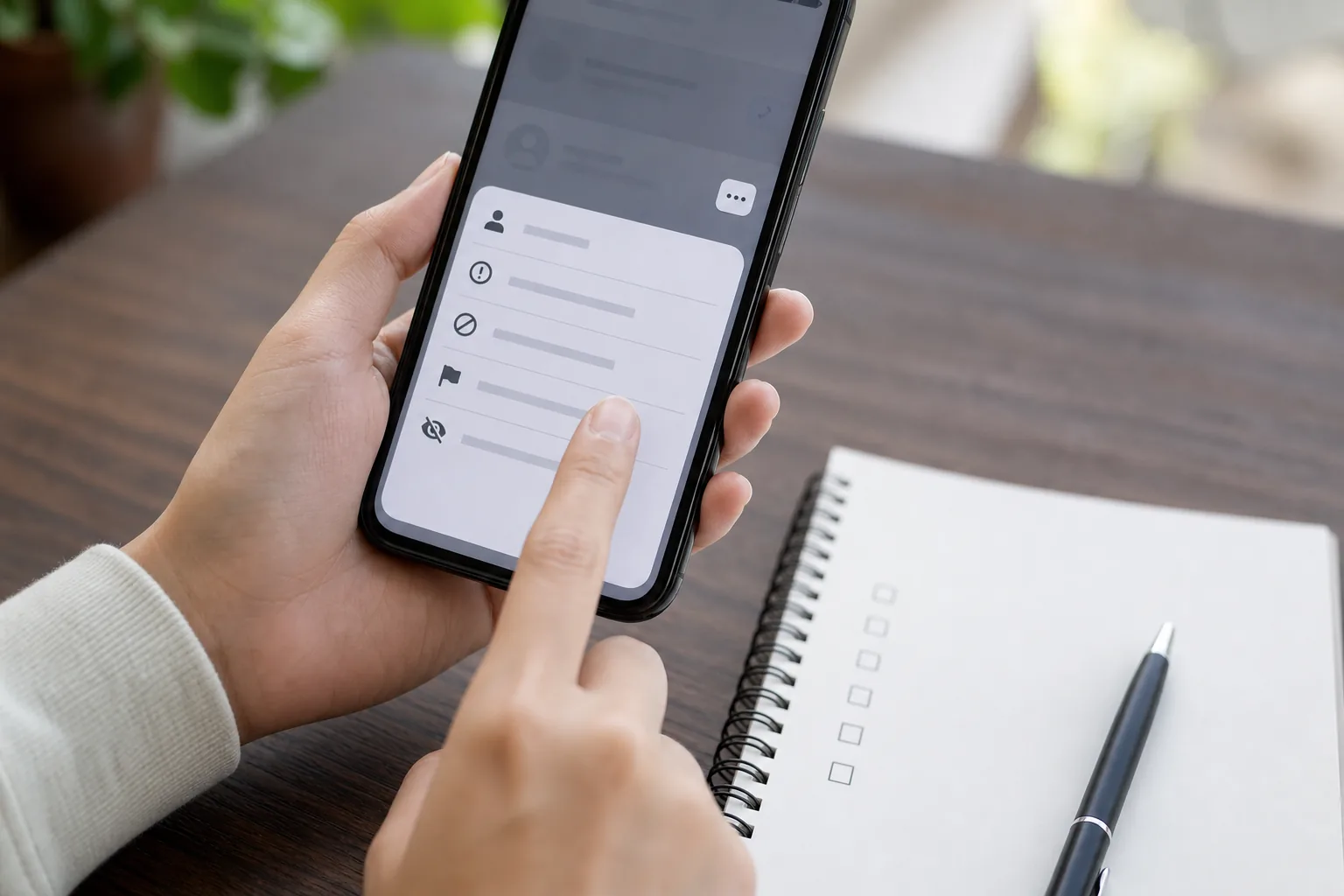
For an impersonating profile, open the three-dot menu and follow the reporting path for an account pretending to be someone else. The exact labels can vary by app version. After submitting the report, stop responding and block the account.
If you already sent money or personal information, stop the next request
Do not accept a claim that one more payment is needed to release your money. Contact both the financial institution you used and the institution that received the transfer, and report the suspected fraud immediately. Whether an account can be temporarily restricted depends on the transaction and applicable requirements, so follow the institution’s instructions.
South Korea’s Cybercrime Reporting System lets a victim begin a report online and attach transfer records, conversations, and scam-site addresses. Its guidance says an in-person police visit and statement are generally still required, with limited exceptions for some multi-victim cases. If you shared a password or verification code, change the Instagram and email passwords, remove unfamiliar signed-in devices, and enable two-factor authentication.
Treat an unsolicited offer to recover the money for an advance fee as another claim that needs verification. A second scam can exploit the urgency of the first loss, so begin with the official procedures of your financial institution and police rather than a stranger promising recovery.
- Immediately tell both the sending and receiving financial institutions that the transfer may be connected to fraud.
- In South Korea, use 112 for an urgent incident, Phishing Safety SOS at 1394 for phishing guidance and reports, and ECRM to begin an online criminal report.
- Preserve the profile, DMs, account details, links, and transfer records, then follow the evidence instructions from the institution and police.
- If you shared a password or code, secure Instagram and email, review signed-in devices, and enable two-factor authentication.
One last check
Before you tap the transfer button
- 01
Did you find the person or company’s social account from its official website instead of using the link in the message?
- 02
Does the conversation avoid promises such as guaranteed principal, fixed returns, or guaranteed recovery of a previous loss?
- 03
Has the sender avoided asking you to move to another messenger, install an unfamiliar app, or share an ID document or verification code?
- 04
Have you shown the conversation to one trusted friend or family member before sending money?
- 05
Did you save the profile URL, username, messages, payment request, and any linked account details?
Sources
Sources used for this article
- Financial Services Commission — Response to scams using social media and messaging apps
- Korean National Police Agency / Korea Policy Briefing — Illegal investment chat-room tactics and prevention
- Korea Policy Briefing — Celebrity impersonation and social-media investment solicitations
- Instagram Help Center — Report an impersonation account
- Instagram Help Center — Information shown in About This Account
- Instagram Help Center — Avoid scam messages
- Financial Supervisory Service FINE — Search for regulated Korean financial companies
- Korean National Police Agency Phishing Safety SOS — Response guidance and reports
- Korean National Police Agency — Cybercrime Reporting System
- Meta Newsroom — Anti-scam and compromised-account recovery tests
The Financial Services Commission, Korean National Police Agency Phishing Safety SOS, and police ECRM pages were rechecked on August 3, 2026. Instagram menu names and locations can vary by app version. A platform or police report does not automatically freeze a bank account or guarantee that money will be returned. The Korean financial and police links below apply to incidents connected to South Korea; use the equivalent regulator and law-enforcement channels in another country.
Was this guide useful?
This browser can leave one heart per article.
Why Instagram Reels Can Be Hard to Stop—and What You Can Change
The European Commission issued preliminary findings about addictive design on Instagram and Facebook. Here is why infinite scroll, autoplay, and notifications matter—and which controls can reduce interruptions.
Adjust Reels time controlsTikTok Teen Accounts: A Five-Minute Privacy Check Beyond the Private Toggle
The European Commission’s findings on TikTok’s protections for minors remain preliminary. Here is a practical check of visibility, account suggestions, downloads, messages, and Family Pairing.
Check a teen account’s visibility